By Dauda Kamara
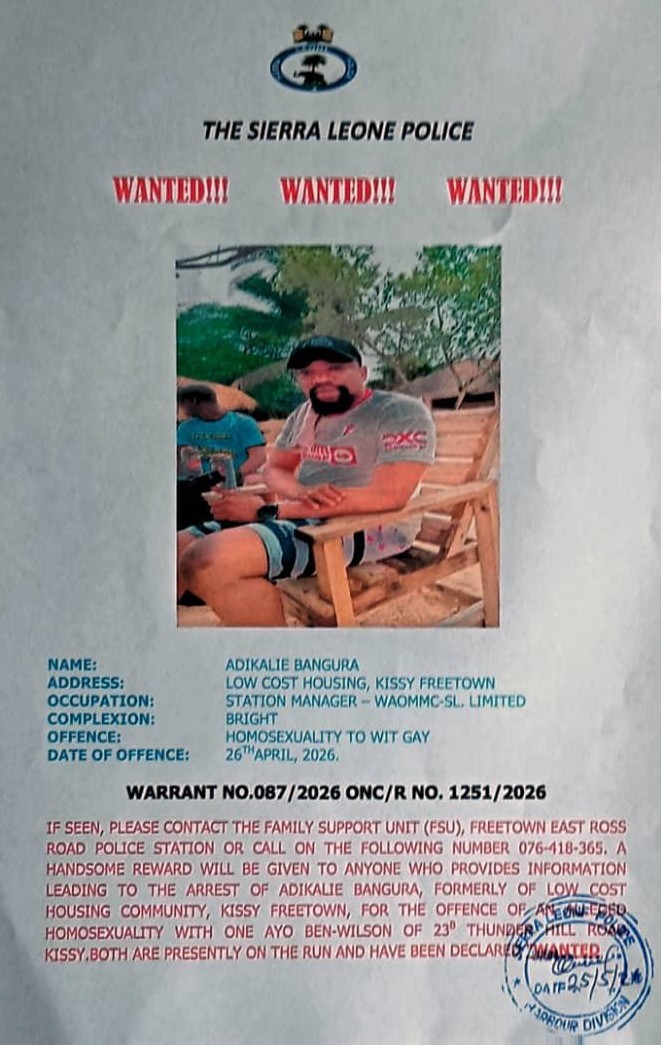
The Sierra Leone Police has declared two men wanted in connection with allegations of same-sex activity, an offence that is prohibited under Sierra Leonean law.
According to report dated 2nd May 2026, filed under Crime Register (C/R) No. 1251/2026, the incident allegedly occurred on 26th April 2026 at Thunder Hill Road, Kissy Mess-Mess, East of city Freetown.
The police identified the wanted individuals as Adikalie Bangura, formerly of Low Cost Housing Community, Kissy, and Ayo Ben-Wilson, of 21 Thunder Hill Road, Kissy Mess-Mess in Freetown.

According to the police report, a complaint was lodged by Mohamed Sesay, community headman residing at 23 Thunder Hill Road in Freetown.
Mr. Sesay reportedly told the police that on the day of the incident he heard Elizabeth Ben-Wilson, the elder sister of Ayo Ben-Wilson, shouting that an “abomination” had occurred after she allegedly suspected her younger brother and Mr. Bangura of engaging in same-sex activity inside a room at their residence.
The complainant further alleged that he alerted community youths, who gathered at the scene and confronted the two men.
Report also say one of the suspects, Ayo Ben-Wilson, was and assaulted before police could arrived at the scene.
Adikalie Bangura was said to have escaped before a handful of the youths reached the scene.
The Sierra Leone Police stated that upon receiving the complaint, a team of armed officers, accompanied by a Crime Officer, reached the scene.
Ayo Ben-Wilson was reported rescue from the hands of angry youth but sustained multiple injuries from the assault. After the incident statements were obtained from the complainant and other witnesses at the scene.
Invitation were later sent on two occasions to relatives of the suspects requesting that they report to the police for interviews. Ayo Ben Wilson is also said to have escape after he was taken to hospital to medical and that the police have now put out a Warrant of Arrest No. 087/2026 for both men.
Meanwhile, Section 61 of the Offences Against the Person Act 1861, a British colonial-era law that continues to apply in Sierra Leone.
“Whosoever shall be convicted of the abominable crime of buggery, committed either with mankind or with any animal, shall be liable… to be kept in penal servitude for life.”
The law has been widely criticized by international human rights organizations for its discriminatory impact on lesbian, gay, bisexual and transgender (LGBT) persons.
Human rights organizations, including Amnesty International and Human Rights Watch, have repeatedly called for the repeal of Section 61, arguing that criminalizing consensual same-sex relations violates internationally recognized human rights, including the rights to privacy, dignity and freedom from discrimination. But all there effects proven not fruitful.
Since the incident the whereabouts of both Adikalie Bangura and Ayo Wilson is unknown and not even family members or close friends could tell. The hunt to the two men continues.Human rights observers note such incidents reflect the profound challenges faced by LGBTQ+ individuals in Sierra Leone, despite constitutional guarantees of rights to free movement and association. As a secular state dominated by Christianity and Islam, both of which frown upon homosexuality, social stigma and customs also strongly reject it. There have been reported cases of jungle justice against people suspected of being gay or lesbian.
Section 61 of Sierra Leone’s Offences Against the Person Act of 1861 criminalizes homosexual acts, punishable by a minimum of 10 years up to life imprisonment. While seldom enforced, the law contributes to an environment of discrimination and threat. Successive governments have failed to legislate protections for LGBTQ+ people. Former Presidents Ahmad Tejan Kabbah and Ernest Bai Koroma faced severe backlash for attempting to do so, and current President Julius Maada Bio’s government has also been unable to convince the public to support such laws. Although Sierra Leone is a signatory to the Universal Declaration of Human Rights, it has not domesticated these international protections into national law.