By Mohamed Konneh
World Bank Group President Ajay Banga on Friday 16th October 2026 told Governors and finance ministers at the 2026 Annual Meetings Plenary that the world is facing a twin challenge of scarce resources and a massive jobs gap, and that development finance must change to meet it.
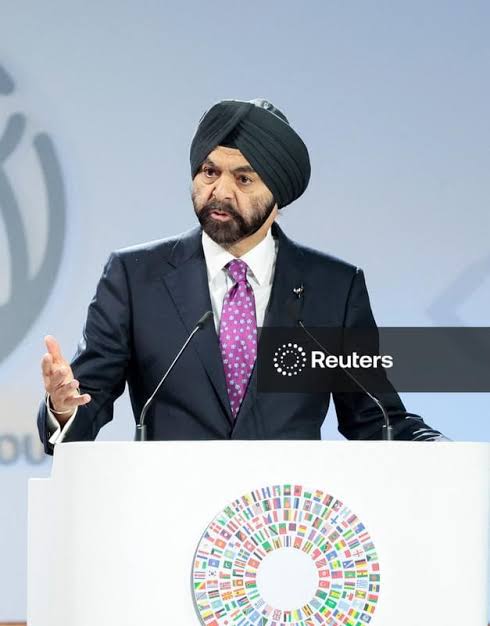
Addressing delegates in Bangkok, Banga thanked the Prime Minister and people of Thailand for their hospitality and laid out progress made since he took over the institution in June 2023.
“When I joined, three truths emerged: The challenges were great. Resources were limited. And the World Bank Group needed to face the wind,” Banga said. “Three years later, the wind has not eased.”
He pointed to persistent conflicts, tighter fiscal space, rising debt burdens, and high cost of essentials from energy to fertilizer. At the centre of his speech was a demographic warning. Over the next 10 to 15 years, Banga said, 1.2 billion young people will enter the job market, but it is projected to offer only about 400 million jobs – leaving a gap of roughly 800 million jobs. “This generation will shape the next century. The choices we make today will help determine how,” he said. A New Model: From Billions to Trillions Banga said the future of development will depend on bringing public finance, private investment, philanthropy, and technology together around what each country needs. He explained that the mix should evolve as countries grow. Where needs and risks are greatest, public and concessional finance will remain essential. As countries grow stronger, private investment should play a larger role.
“To be clear, success arrives when we are no longer needed by a country,” he noted, adding that 35 countries have already moved from IDA to IBRD, and 23 are now IDA donors themselves.
To achieve that, he said the Bank had to change itself first. Project preparation time was cut from 19 months to nine months. 153 scorecard measures were replaced with 22 focused on impact. Pay-for-results financing increased from about one-third to half of financing. And the Bank’s balance sheet was reengineered to create more than $100 billion in additional IBRD lending capacity over a decade.
He also said Multilateral Development Banks are now working together more closely. The number of projects on the Bank’s digital co-financing platform has tripled in two years to about 250 projects, seeking $138 billion in financing.
Three Pillars for Jobs Banga said the Bank’s jobs strategy, developed by its Jobs Council, rests on three pillars:
First, physical and human infrastructure – electricity, water, transport, digital connections, plus health, education and skills. Last year, the Bank committed $40 billion, nearly one-third of its financing, to these foundations.
Second, regulatory and policy certainty – strong institutions, good governance and clear rules. 30 percent of public sector financing last year supported policy and institutional reform.
Third, scale – addressing risks that hold investment back, including currency risk and access to finance, through guarantees, equity and local currency financing.
According to Banga, the results are beginning to show. In FY22, before the reforms began, the Bank mobilized roughly $35 billion in private capital. Last year, that figure reached $112 billion – a threefold increase.
“Alongside our own financing, total financing exceeded $230 billion,” he said. Mobilization nearly tripled in lower-middle-income countries, quadrupled in upper-middle-income countries, and more than doubled across Africa.
He however admitted a challenge remains in low-income countries, where mobilization held flat. To address that, the Bank launched a new MSME strategy this week to reach small businesses, which he described as critical in fragile and conflict-affected settings.
Banga said participation is broadening, with capital mobilized from investors in 110 countries last year, led by the United States, United Kingdom and India, but also including Romania, Chile, Poland and Brazil.
Nearly 55 percent of financing and private capital mobilized went to infrastructure and energy, agribusiness, health, tourism and value-added manufacturing – sectors focused on job creation. Climate co-benefits reached $96 billion, with $48 billion coming from private capital.
Technology, Energy, Water and Health On technology, Banga drew a distinction between “Big AI” and “small AI,” arguing that while frontier models may be beyond many developing countries, practical AI can help farmers improve yields, teachers tailor instruction, and entrepreneurs reach new customers.
He outlined major sectoral ambitions: On energy, through Mission 300 with the African Development Bank, the goal is to bring electricity to 300 million people in Africa by 2030. So far, 59 million have gained access, with the pace accelerating from 12 million in FY24, to 18 million in FY25, to 29 million last year. The approach includes renewables, hydro, gas, nuclear, transmission and storage.
On water, the ambition with partners is to improve water security for up to one billion people by 2030, with the Bank committed to 400 million.
In agriculture, partners are working to help 300 million smallholder farmers move from subsistence to surplus by 2030, with the Bank committed to 200 million. Through Health Works, supported by Japan, the ambition is to reach 1.5 billion people with quality, affordable health services by 2030, with roughly 600 million already reached.
In critical minerals, the Bank plans to multiply its business five times in five years, and has launched its first country compacts to build local industries. Creating a New Asset Class Looking to the next phase, Banga said the Bank is expanding its presence in New York, Frankfurt, Milan and Tokyo to meet private sector clients where investment decisions are made.
He also announced a major push to solve a basic constraint in development finance: a dollar can only be in one place at a time. Six multilateral development banks are now creating common ways to assess, document, package and transfer investments so that projects financed today can be held by other long-term investors like pension funds and insurers tomorrow.
“If we get this right, the size of our balance sheet no longer defines the scale of our ambition – and we will bend the curve of development forever,” he said.
Closing his remarks with a reference to the Bank’s founding in Bretton Woods in 1944, Banga said prosperity is not a prize one nation wins from another, but “a fire that warms every house within reach.”
“A job is not a statistic. A job is dignity,” he said. “The jobs gap is a projection. It does not have to be our future. That future is ours to build.”