By Komba Fillie
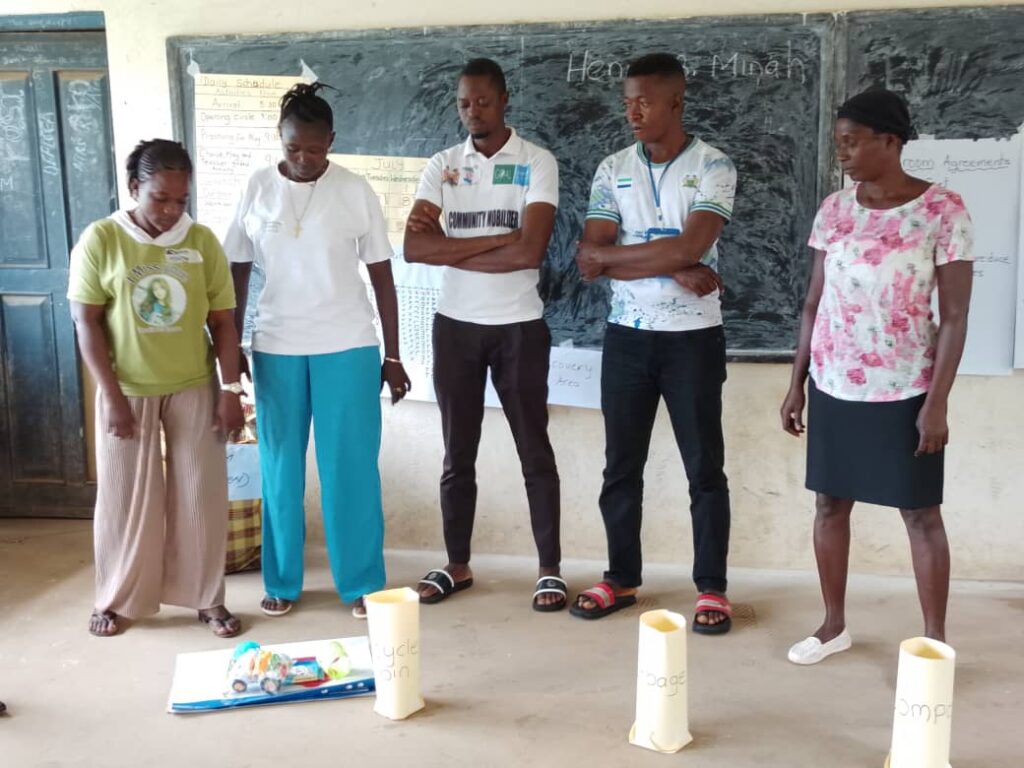
As part of a nationwide teacher training initiative by the Government of Sierra Leone through the Ministry of Basic and Senior Secondary Education (MBSSE) with support from UNICEF, a cross-section of media practitioners visited one of the training sites in Kabala, Koinadugu District on Thursday to obtain first-hand information on the programme’s success. During the training session, teachers were instructed on understanding why play matters in pre-primary school education, the goals of the pre-primary curriculum, and how to effectively explore the teacher guide and workbook.
The Ministry of Basic and Senior Secondary Education has commenced a refresher training programme for pre-school teachers across the country, targeting 155 participants from government and government-assisted schools in Kono District alone. The training, which commenced on Thursday, 23 July 2026, is aimed at equipping teachers with the knowledge and practical skills required to effectively support children between the ages of three and five years.
Speaking during the training, an official of the Ministry explained that the programme targets teachers responsible for pre-school classes and is designed to ensure they acquire the appropriate knowledge and methodologies to take back to their schools and improve teaching and learning. He stated that all government and government-assisted pre-schools in the district had been targeted, with teachers mobilised from across the district to participate in the training.
According to him, early childhood education remains particularly important in parts of the country where pre-school education is still a relatively new phenomenon and therefore requires sustained investment in teacher training. He explained that children who attend pre-school are more likely to adapt to the school environment and successfully transition to primary education compared to those who enter Class One without prior exposure to formal schooling.
“A pupil who is transitioning from pre-school to primary is already acquainted with the school environment. So you see them going through the entire primary school education without dropping out,” he said.
The official noted that the Ministry had identified early childhood education as an important intervention for improving school retention and reducing the likelihood of children dropping out of school at the early stages of their education. He said the training forms part of a broader teacher professional development programme covering pre-school and primary education, with similar training programmes expected to target teachers from Class One through Class Four.
On sustainability, he disclosed that head teachers had also been included in the training to ensure that the knowledge and skills acquired could be cascaded to newly recruited teachers in the future. He explained that if a trained teacher leaves the service and is replaced by another teacher, the head teacher would be able to pass on the knowledge and practical skills acquired during the training. He described the inclusion of head teachers as one of the strategies adopted by the Ministry to ensure the sustainability and continuity of the training programme.
The training is expected to strengthen the capacity of pre-school teachers, improve the quality of early childhood education and help ensure that children are better prepared to transition successfully into primary school.
It could be recalled that the UNICEF–Global Partnership for Education (GPE) Teacher Training Programme, themed “Delivering Foundations of Learning for All,” is a significant intervention in the country’s education sector. The Government of Sierra Leone, with support from the Global Partnership for Education and UNICEF as the grant agent, is implementing the US$50 million Delivering Foundations of Learning for All Programme spanning 2023 to 2027 to strengthen foundational learning from pre-primary to Primary Four.
As the programme enters its fourth and final year, it has made significant investments in teacher development, learning materials, education data systems, research, and learning assessments to improve literacy and numeracy outcomes for children across Sierra Leone. Beginning this week, the Government is conducting a two-week national refresher training programme for pre-primary teachers, aimed at strengthening teaching practices and improving learning outcomes for young learners.
Foundational learning refers to the essential literacy, numeracy, and socio-emotional skills that children need in their early years to succeed in school and later life. Strong foundational skills enable children to continue learning effectively and participate meaningfully in society. The GPE-funded programme seeks to improve these outcomes by strengthening teacher capacity, providing high-quality teaching and learning materials, and generating evidence to inform education reforms.
The programme has made major investments in teacher professional development and classroom support, with more than 39,000 pre-primary and primary school teachers trained on new teaching and learning materials and child-centred pedagogy. Over 5,000 pre-primary to Primary Three teachers continue to receive professional development support nationwide, while more than 6,000 pre-primary teachers, head teachers and School Quality Assurance Officers have been trained. Additionally, more than 300 master trainers and facilitators have had their capacity strengthened, and over 26,000 teachers, head teachers and School Quality Assurance Officers have been trained using improved training models and the Learning Passport platform.
To support foundational literacy and numeracy, new curriculum-aligned teaching and learning materials have been developed for pre-primary and Primary One to Three numeracy. More than 1.6 million learner workbooks and textbooks have been printed and distributed nationwide, with more than 1.6 million children benefiting from these materials.
The programme has also strengthened evidence-based decision-making across the education sector through the development of a Foundational Learning Data Strategy to guide education data initiatives. Some 220 School Quality Assurance Officers and 17 district IT clerks were recruited and equipped with tablets and motorbikes, and they have been trained in digital data collection and classroom observation. Classroom observations have been conducted in more than 6,000 classrooms, including over 5,000 Primary One and 1,000 pre-primary classrooms, with digital monitoring systems helping improve classroom support and data-driven planning.
The programme has generated valuable evidence to strengthen education reforms through partnerships between UNICEF, MBSSE and UNICEF Innocenti to study the implementation of foundational learning interventions nationwide. Government staff have been trained to conduct research, interviews and focus group discussions, building national research capacity. Evidence from nearly 5,000 classroom observations and approximately 1,500 pupil workbooks has been analysed, with research findings showing that structured teaching approaches are being adopted at scale while also highlighting areas needing further improvement, particularly independent writing and formative assessment practices. These findings are informing practical recommendations to enhance implementation and improve learning outcomes.
To measure progress in foundational learning, National Learning Assessments have been conducted for pre-primary and Primary Two learners, with more than 6,000 Primary Two pupils and nearly 3,000 pre-primary pupils assessed. The assessment results provide important benchmarks for measuring learning outcomes and informing education policies.
As part of the ongoing national refresher training for pre-primary teachers, media practitioners have had the opportunity to observe classroom-based teacher training sessions, interact with teachers, facilitators and education officials, learn more about foundational learning reforms, and report on progress, challenges and innovations in Sierra Leone’s education sector. Media coverage will help increase public awareness of education challenges and achievements while highlighting the contributions of the Government of Sierra Leone, the Global Partnership for Education and UNICEF to improving learning outcomes for children.
Despite significant progress, several challenges continue to affect children’s access to quality education and learning outcomes, including high numbers of out-of-school children, limited access to pre-primary education, low retention and transition rates, poverty, disability, gender inequality and harmful social norms, shortages of qualified teachers and high reliance on volunteer teachers, weak teacher workforce management including uneven deployment and low teacher motivation, and school safety and child protection concerns.
The pre-primary level is referred to as P0, while P1, P2 and P3 refer to Primary One, Primary Two and Primary Three respectively. The GPE-funded programme runs from 2023 to 2027 and supports foundational learning for nearly 1.5 million children across Sierra Leone, with UNICEF serving as the Grant Agent for the programme on behalf of the Global Partnership for Education.
Every child deserves the opportunity to acquire foundational literacy and numeracy skills. Through the Government of Sierra Leone’s partnership with GPE and UNICEF, significant progress is being made to strengthen teaching, provide quality learning materials, use data for decision-making, and ensure that children develop the foundational skills they need to thrive.