By Mohamed Konneh
For years, Sierra Leone’s Produce Monitoring Board (PMB) operated from the margins of global commodity trade.
When international coffee and cocoa stakeholders met to shape industry decisions, Sierra Leone had little influence. When farmers questioned persistently low farmgate prices, a difficult reality remained: global buyers lacked confidence in the country’s systems. When the European Union demanded proof that exports were not linked to deforestation, there was limited geospatial evidence to provide.
Debt, uncertainty and institutional weaknesses defined that period.
That narrative, according to PMB Executive Chairperson Raymond Bob Katta, changed in 2026.
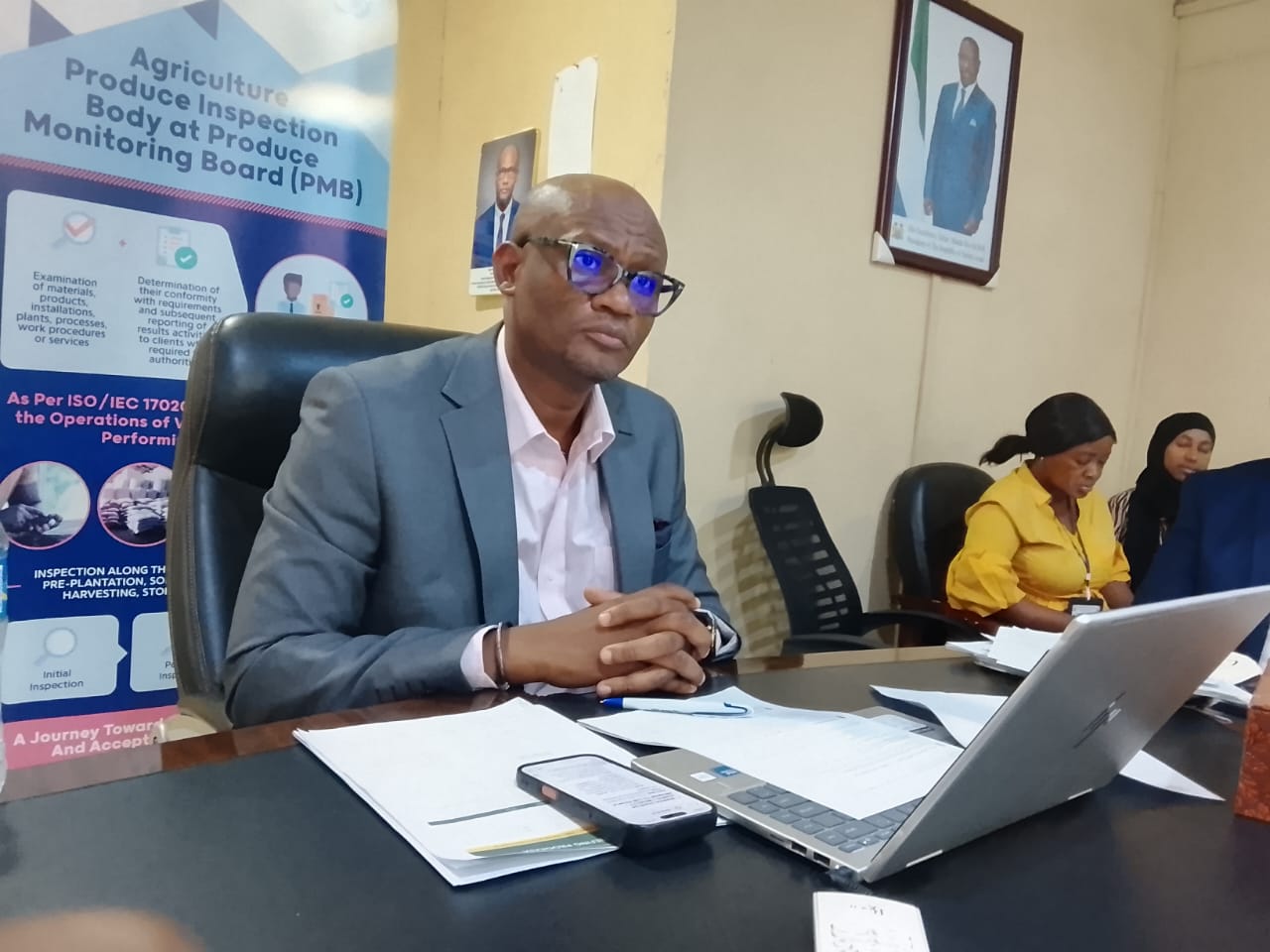
Briefing journalists in Freetown on Wednesday, June 3, 2026, Katta framed the Board’s transformation around a simple message: “Vision established. Results delivered.”
Clearing Debt, Reclaiming Influence
For years, Sierra Leone carried outstanding financial obligations to the International Coffee Organization (ICO), International Cocoa Organization (ICCO), and Inter-African Coffee Organization (IACO). The consequences were significant: suspended voting rights and diminished participation in global policy and market discussions.
“In 2026, PMB settled all outstanding obligations — completely,” Katta stated.
Beyond institutional recognition, the impact carries practical implications for farmers across producing districts such as Kailahun and Kenema. Sierra Leone has regained representation in international platforms where commodity standards, market priorities and strategic decisions are shaped.
“Credibility in trade is not abstract,” Katta said. “It is the difference between a buyer saying ‘maybe’ and a buyer saying, ‘let’s sign’.”
From “Lost Coffee” to International Recognition
Sierra Leone’s Coffea stenophylla, once regarded as a forgotten species, is attracting renewed international attention.
Unlike conventional Arabica varieties, stenophylla demonstrates stronger tolerance to heat and drought — characteristics increasingly valued as climate pressures intensify across global coffee-producing regions.
This growing relevance contributed to Sierra Leone’s selection as the 2026 IACO Country Spotlight, positioning the country prominently before specialty coffee buyers, investors and industry actors from Europe, the Middle East and Asia.
For producers, the implications are potentially transformative. Coffee previously marketed as a bulk commodity is increasingly being positioned within higher-value specialty markets where quality, traceability and origin command premium pricing.
Those premiums can translate into tangible household outcomes — education costs, healthcare access and improved livelihoods for farming families.
Compliance Before the Deadline
A major challenge now confronting coffee and cocoa exporters is the European Union Deforestation Regulation (EUDR), which takes effect on December 30, 2026.
Under the regulation, exporters must demonstrate that coffee and cocoa products are not sourced from land deforested after December 31, 2020. Non-compliance risks exclusion from a market representing a substantial share of global demand.
PMB, Katta said, moved ahead of the deadline.
A 2025 pilot initiative mapped 163 coffee and cocoa farms using GPS polygon technology, creating digital farm boundaries that can be cross-verified through satellite analysis.
The initiative is now being expanded to reach 40,000 farmers nationwide.
The objective is clear: traceable farms, traceable commodities and stronger income security for thousands of agricultural households.
The practical shift is significant. Where producers once described farms through broad geographic references, digital coordinates now allow precise verification — an increasingly critical requirement in modern agricultural trade.
Strengthening Institutional Capacity
Katta emphasized that compliance does not begin in export markets; it begins within the institution itself.
PMB has introduced strengthened standard operating procedures, expanded digital inspection systems capable of functioning offline, reinforced audit mechanisms and adopted a stricter compliance culture.
Board personnel have also completed specialized training supported by the United Nations Industrial Development Organization (UNIDO) on Product Certification Excellence to strengthen readiness for international certification requirements.
“Compliance begins at home,” Katta said. “When buyers trust PMB, they trust the farmers and systems PMB certifies.”
Staff Welfare and National Scale-Up
Institutional reform, Katta noted, must also address staff welfare.
Engagements with the Ministry of Finance have resulted in phased salary improvements affecting 30 PMB staff members, with expectations of broader coverage in subsequent stages.
To move from pilot implementation to nationwide deployment, PMB has developed a broader scale-up initiative for farm mapping and digital traceability. Full implementation, however, remains dependent on financing arrangements and establishment of a national traceability platform.
A Message to Farmers, Exporters and Partners
Katta directed his remarks toward three constituencies central to the sector’s future.
To farmers:
“Your farm is now data. Your work is becoming bankable. Stay committed. The market is shifting toward you.”
To exporters:
“Standards are not a burden; they are your market passport. PMB will train you, inspect alongside you and support your transition.”
To development partners and investors:
“PMB is no longer a risk profile. It is a credible partner. Engage with confidence. Invest with confidence.”
Katta described 2026 as “the Year of Compliance and Accountability.”
From debt to dialogue. From uncertainty to data. From limited participation to international visibility.
Across coffee and cocoa-producing districts, the season is advancing. Coffee cherries are ripening. Cocoa pods are maturing.
This time, Sierra Leone’s agricultural sector is drawing attention not through vulnerability narratives, but through emerging market opportunity.
The country, Katta argued, has done more than clear outstanding obligations.
It has begun rebuilding credibility, restoring confidence and reclaiming its place in the global conversation.
And, as he concluded, the future is often determined by who has a seat at the table.