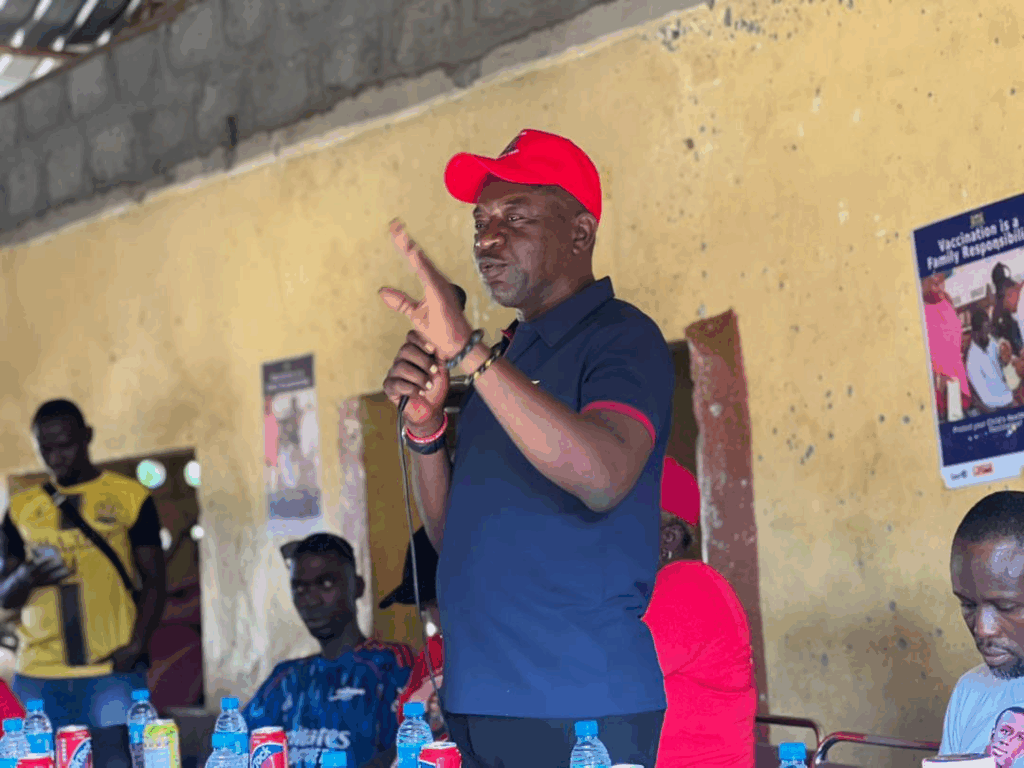
Former Deputy Minister of Information and former Deputy National Publicity Secretary of the All People’s Congress, Cornelius Deveaux, has officially declared Dr. Ibrahim Bangura as the party’s next flagbearer during a gathering in Waterloo. Speaking as keynote speaker on behalf of Dr. Bangura, Deveaux outlined a comprehensive delegate strategy, categorized party coordinators, and launched what he described as a “Love Not Hate, Build Bridges Not Walls” campaign. The event brought together members of the DIB Movement, DIB Ladies, Gen Z 4 Change, and ward coordinators under the DIN structure. Deveaux addressed them for over 40 minutes, combining endorsement, electoral mathematics, and instructions for mobilization ahead of district, constituency, and national convention elections.
Deveaux opened his address with a declaration of Dr. Bangura’s visibility and standing among the public. “Dr. Ibrahim Bangura — you cannot call his name where people do not recognize his name. In the Bible and the Qur’an he quoted. In this generation, Dr. Ibrahim Bangura is the chosen one,” he said. The statement was met with applause and chants from supporters. Many attendees held placards bearing Dr. Bangura’s image and wore T-shirts branded with the DIB Movement logo. Deveaux returned to the theme of recognition several times, suggesting that Dr. Bangura’s name had moved beyond party circles. He extended the claim to religious spaces, telling the gathering that in both mosques and churches, leaders are preaching about Dr. Ibrahim Bangura. The reference to both Islamic and Christian contexts appeared intended to position Dr. Bangura as a figure with cross-community appeal. Deveaux did not provide specific examples of sermons or religious discussions during the address, framing the comment as an observation of public discourse rather than an official endorsement from religious institutions.
The central strategic portion of Deveaux’s speech focused on the APC’s delegate system. He stated that the party has 1,800 delegates who will vote at the National Convention to elect the flagbearer, setting a target of 80 percent support for Dr. Bangura. “The party has 1,800 delegates. So our responsibility is to work as one to have at least 80 percent of the delegates’ votes,” Deveaux said. “This is why Dr. Ibrahim Bangura decided to launch the ‘Love Not Hate, Build Bridges Not Walls’ campaign. And the slogan he initiated is ‘Heal, Unite, Build’.” The 80 percent figure translates to 1,440 delegates. Deveaux did not explain how the target was calculated, but he presented it as the threshold needed to secure the nomination, emphasizing that achieving it would require coordinated work across all levels of the party structure. He linked the target directly to the campaign theme, presenting “Love Not Hate, Build Bridges Not Walls” as both a political strategy and a method for engaging delegates, with the slogan “Heal, Unite, Build” repeated at intervals during the address.
Deveaux spent several minutes categorizing the types of party coordinators present and their roles in mobilization. He corrected an earlier formulation and specified four categories based on ward, district, and executive levels. The categorization clarified the structure he expects coordinators to operate within, including ward-level coordinators responsible for community and polling center engagement, district-level coordinators responsible for coordinating across wards within a district, a secondary layer of coordination which Deveaux did not define in detail but presented as distinct from primary ward and district roles, and ward executives who are not in constituency executives and national executives. Deveaux emphasized the distinction between ward executives and those serving at constituency or national level, noting that some party members hold ward positions without having roles in constituency or national structures and saying this group had specific responsibilities in delegate outreach. The categorization appeared designed to ensure that coordinators understood where they fit within the mobilization plan, particularly those operating at ward level without higher executive positions.
After outlining the categories, Deveaux turned to the practical task of delegate engagement, telling coordinators that the work must begin at constituency level and must be comprehensive. “Each constituency delegate — we have the responsibility now to reach each and every one of them in their various places, that this is our party and we are all one, but the right person to cast our vote for in the APC is Dr. Ibrahim Bangura,” he said. The instruction placed responsibility on coordinators to identify delegates in their areas and engage them directly. Deveaux stressed the phrase “each and every one,” suggesting a door-to-door or one-on-one approach rather than reliance on mass meetings alone. He framed the engagement in terms of party unity, emphasizing that while the party belongs to all, the right person to vote for is Dr. Ibrahim Bangura.
Deveaux concluded the strategic section of his address with a direct instruction to coordinators as they left the meeting. He urged them to reach out to people eligible to vote in the upcoming elections, from district and constituency conventions to the National Convention. The sequence he outlined begins with district elections, followed by constituency conventions, and culminates in the National Convention. He presented district and constituency elections as the foundation for the party’s flagbearer selection, stating that this is the foundation for all in the APC to stand firm to choose leaders that will become the legitimate members to cast their votes at the National Convention to choose the next flagbearer, and that person is Dr. Ibrahim Bangura. By describing district and constituency elections as “the foundation,” Deveaux positioned them as the critical first step, suggesting that the choice of leaders at those levels would determine who becomes delegates and, by extension, who decides the flagbearer.
Throughout the address, Deveaux referenced Dr. Bangura’s campaign philosophy, naming it “Love Not Hate, Build Bridges Not Walls” and identifying the slogan as “Heal, Unite, Build.” He did not provide a detailed policy breakdown of the three components during this address, but the phrase “Heal, Unite, Build” was repeated after he introduced it, and supporters responded by chanting the words. The campaign name and slogan introduce a unifying message, and in the context of internal party contests where factions often compete, the language of healing and unity may appeal to members seeking to avoid division. Deveaux linked the philosophy to Dr. Bangura’s approach without elaborating on specific policy proposals, focusing instead on the message and its application to delegate mobilization.