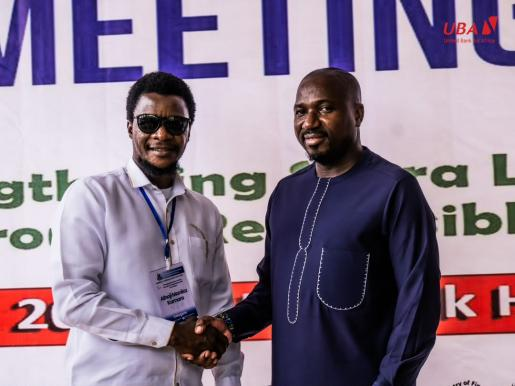
There was a moment of deep silence inside the conference hall in Makeni before the applause broke out. “I am a son of the media.” With those heartfelt words, Mohamed Alhajie Samoura, Managing Director and Chief Executive Officer of UBA Sierra Leone and President of the Sierra Leone Bankers Association, immediately captured the attention of journalists gathered at the 2026 Annual General Meeting of the Sierra Leone Association of Journalists. Speaking on the theme, “Strengthening Sierra Leone’s Economy Through Responsible Journalism,” the UBA MD and CEO delivered what many described as a timely, practical, and inspiring keynote address that challenged journalists to see themselves not only as storytellers but also as nation builders.
From the very beginning, he made it personal. He spoke about his father, Mohamed Samoura, one of the pioneer founding fathers of the Sierra Leone News Agency and a former Commissioner of the Independent Media Commission. He recalled growing up in a home where newspapers, radio discussions, and debates about national issues were part of everyday life. “The media is not just an industry I respect from the boardroom of a bank,” he said. “It is part of my family DNA.” He also surprised many in the audience when he revealed that his first job after university was as a journalist at the Standard Times under the late Philip Neville. That revelation created an instant connection with the audience, reminding everyone that the man speaking to them understood the profession from experience.
But beyond the personal stories, his message was clear. In today’s world, where false information spreads quickly through social media and sensational headlines often gain more attention than facts, responsible journalism has become more important than ever. “Responsible journalism is no longer just a moral choice,” he said. “It is the ultimate currency of trust.” He explained that trust, transparency, and accountability are the foundations of every successful economy, noting that investors and businesses need reliable information before making important decisions. “Capital is cowardly,” he remarked. “It only goes where it feels safe.”
Using examples from other African countries, the UBA MD and CEO showed how responsible journalism can support economic growth. He pointed to Ghana, where media freedom helped build investor confidence, and Rwanda, where strategic communication helped transform the country’s image and attract tourism and investment. “The stories we tell about ourselves matter,” he said. “A country’s image is one of its greatest economic assets.” Turning to Sierra Leone, Samoura made it clear that responsible journalism does not mean hiding the country’s problems. He encouraged journalists to continue exposing corruption, reporting on inflation, and highlighting the struggles of ordinary people. However, he challenged them to go further. “Report on the problems,” he said, “but also report on the solutions.” He urged journalists to move away from focusing only on conflict and political arguments and instead pay more attention to issues that affect development, such as agriculture, education, financial inclusion, technology, infrastructure, and entrepreneurship.
One of the strongest moments of his speech came when he asked how many journalists had taken time to read Sierra Leone’s Medium-Term National Development Plan. “We cannot build an informed society on a diet of political gossip while the plans for our country’s future gather dust on office shelves,” he said. He encouraged journalists to understand national priorities such as the Feed Salone initiative, digital transformation, and economic diversification so that they could ask better questions and hold leaders accountable through informed reporting.
Samoura also spoke openly about the difficult conditions under which many journalists work. “We cannot talk about independent journalism if the journalist is hungry,” he said. He acknowledged that many media houses struggle to pay salaries, buy fuel, and keep their businesses running. He warned that relying too heavily on politicians or occasional handouts could threaten the independence of the media. “If someone is the only reason your media house survives,” he warned, “it becomes difficult to hold that person accountable.” He therefore challenged media owners and SLAJ leadership to think differently, calling for media entrepreneurship through innovation, digital subscriptions, specialised reporting, stronger partnerships, and even strategic mergers that could create stronger and more sustainable media institutions.
At the same time, he reaffirmed UBA Sierra Leone’s commitment to supporting the media. “We do not see support for the media as charity,” he said. “We see it as an investment in Sierra Leone’s development.” As he concluded his address, the UBA MD and CEO reminded everyone that building Sierra Leone is a shared responsibility. “The future of Sierra Leone’s economy will not be written by government alone. It will not be written by the private sector alone. It will be written by all of us through the stories we tell, the truths we uncover, and the accountability we demand.”
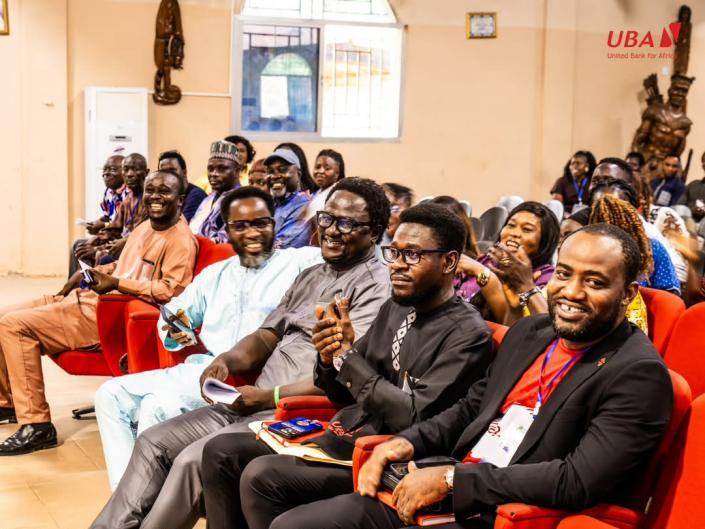
His words received repeated rounds of applause from the audience. Many journalists, editors, and media stakeholders described the speech as one of the most meaningful keynote addresses delivered at a SLAJ AGM in recent years. Some said it was refreshing to hear a keynote speaker move beyond formalities and offer practical ideas that addressed the real challenges facing both the media and the country. Others praised him for speaking as someone who understood journalism and respected its role in society. “It was a true keynote address,” one participant said after the session. “It was honest, timely, challenging, and inspiring. He did not just praise journalists. He challenged us to think differently and to do better.” As the audience rose to give him a standing ovation, one message remained clear: the strength of Sierra Leone’s economy and the strength of its journalism are closely connected. The future of the nation will not depend only on policies, investments, or government decisions. It will also depend on journalists who report with truth, fairness, responsibility, and courage, because sometimes, changing a nation begins with changing the stories it tells about itself.