How EDSA’s Revenue Collection Contracts Work-and What Due Process Looks Like
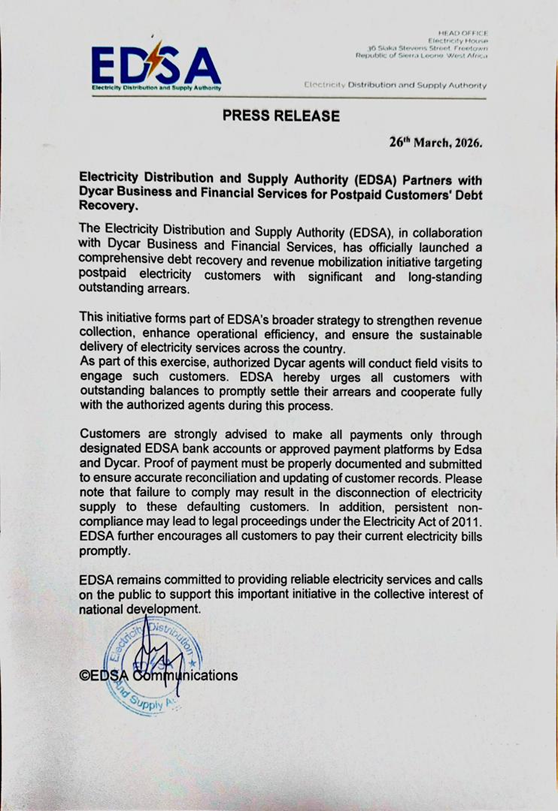
When the Electricity Distribution and Supply Authority (EDSA) announced on 26th March 2026 that it had partnered with Dycar Business and Financial Services to recover debts from postpaid customers, the move put a spotlight on a question many Sierra Leoneans ask: Who collects the light bill money, and what rules govern how they’re chosen?
The EDSA-Dycar announcement lays out the basics of one such arrangement. But to understand due process, you have to look at the legal framework, past practice, and the checks meant to keep revenue collection accountable.
1. The Stakes: Why Collection Contracts Matter
EDSA’s core problem is commercial losses. Postpaid customers with “significant and long-standing outstanding arrears” are a major drain on revenue. Without cash, EDSA struggles to pay power suppliers like Karpowership and TRANSCO-CLSG — a gap that in 2023–2024 led to nationwide blackouts and the resignation of Energy Minister Kanja Sesay after debts hit $48m.
So collection isn’t just paperwork. It determines whether hospitals keep power and whether EDSA can avoid another debt crisis.
2. What EDSA’s 26th March 2026 Press Release Actually Says
The release outlines the current model with Dycar:
Scope: “Comprehensive debt recovery and revenue mobilization initiative” targeting postpaid defaulters.
Method: “Authorized Dycar agents will conduct field visits” to engage customers.
Payment rules: Customers must pay only through designated EDSA bank accounts or approved payment platforms by EDSA and Dycar. Proof of payment must be documented for reconciliation.
Consequences: Non-compliance “may result in disconnection” and “persistent non-compliance may lead to legal proceedings under the Electricity Act of 2011.”
What the release doesn’t detail: How Dycar was selected, the value/terms of the contract, commission structure, duration, or performance metrics.
3. The Legal Framework: How Contracts Are Supposed to Be Awarded
Revenue collection for a public utility like EDSA falls under Sierra Leone’s public procurement rules:
Public Procurement Act 2016: Requires competitive bidding for public contracts above set thresholds, with limited exceptions for single-source procurement. Single-source must be justified and approved by the National Public Procurement Authority (NPPA).
Electricity Act of 2011: Gives EDSA power to disconnect for non-payment and to take legal action, but does not exempt it from procurement law when hiring third parties.
ACC oversight: Since March 2020, the Anti-Corruption Commission has an MoU with the Ministry of Energy to “detect and prevent acts of corruption in the energy sector,” including illegal connections and diversions. That MoU was signed precisely because revenue leakage was a known problem.
So due process means: competitive tender, public notice, NPPA approval, published contract, and clear safeguards against conflict of interest.
4. Key Questions that needs answers
If you’re scrutinizing any EDSA revenue collection contract — Dycar or otherwise — these are the documents and answers to request:
Was there an open tender advertised by NPPA?
Confirms competitive selection vs. single-source NPPA website, EDSA procurement unit
What is Dycar’s commission/fee structure? Prevents perverse incentives or overcharging
Contract summary from EDSA
What safeguards stop agents collecting cash?
EDSA’s release says “only designated bank accounts” — is that enforced?
EDSA customer service, ACC
How are disputes handled if a customer says they paid? “Proof of payment must be documented” — who resolves errors? EDSA, Consumer Protection Agency
What is the contract duration and performance review? Ensures accountability if targets aren’t met
EDSA Board, Ministry of Energy. Any declared conflicts of interest by evaluators? Procurement Act requires disclosure.
NPPA, ACC declaration forms
6. What Happens Next
EDSA says the Dycar partnership is part of a “broader strategy to strengthen revenue collection” for sustainable electricity delivery. For that strategy to keep public trust, the contract terms, selection method, and agent accountability need to be as transparent as the disconnection warnings.
The Ministry of Energy, which directly supervises EDSA since 2024, and the ACC both have mandates to ensure due process isn’t just promised in press releases, but documented.
See Press Release: