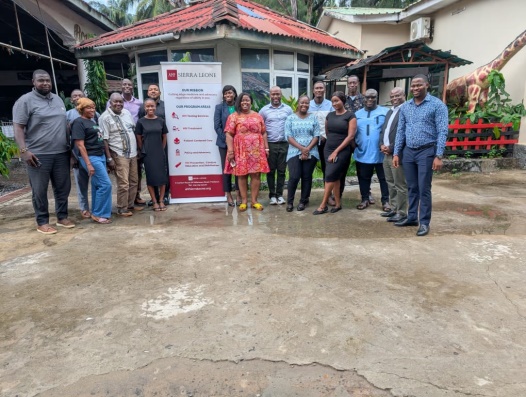
A three-day Pandemic Preparedness and Response Learning Sessions for the Building Pandemic-Ready Communities (BPRC) project officially opened at the Family Kingdom in Freetown. The Eastern Africa National Networks of AIDS and Health Service Organizations (EANNASO), a regional network of AIDS and health service organisations working across Anglophone Africa, is spearheading the initiative in collaboration with the AIDS Healthcare Foundation (AHF) Sierra Leone Country Office.
Introducing the project background at the ceremony, the lead facilitator from EANNASO, John Bev, said his work is to empower and support communities and civil society to effectively contribute to national HIV, TB, malaria and other health-related responses. He noted that the BPRC project is being implemented in Rwanda and Sierra Leone with the aim of strengthening community-level pandemic preparedness and response systems through enhanced community engagement, public awareness and sustainable community-led approaches.
He said observed that the global health system continues to face recurring pandemics and health emergencies, adding that communities are central to the implementation of the project and pointed out the importance of community strengthening. He stated that the rationale for the project stems from frequent and increasing health emergencies, limited community preparedness, risk communication challenges and issues of trust, which call for sustainable, community-led solutions aligned with global and national priorities. The goal, he said, is to strengthen the capacity of civil society, communities and institutions in pandemic preparedness, response and recovery. He highlighted key objectives including empowering communities, enhancing public awareness, and developing and disseminating community-led tools for pandemic preparedness and response.
Making a statement on behalf of the AIDS Healthcare Foundation in Sierra Leone, the AHF Medical Manager, Dr. Ifeanyi Egeonu, underscored the importance of the training. He said the initiative, implemented in partnership with EANNASO, reflects a shared commitment to strengthening community resilience and preparedness for future public health emergencies. He recalled that Sierra Leone was among the hardest-hit countries during the Ebola outbreak, recording nearly 9,000 infections and close to 4,000 deaths between 2014 and 2016, which severely weakened the country’s health system and disrupted the economy.
Dr. Egeonu noted that experiences with COVID-19 and recent regional concerns around Mpox have further reinforced the importance of resilient health systems, rapid emergency coordination and strong community trust in responding to public health threats. He stressed that communities are not only beneficiaries of health interventions but also the first line of defence during public health emergencies. These experiences, he said, have highlighted the critical importance of investing in community systems, enhancing risk communication, strengthening surveillance mechanisms, and ensuring effective coordination between communities and formal health structures.
He recalled that during the Ebola epidemic in Sierra Leone, community leaders, youth groups, women’s organisations, religious institutions and local health workers played critical frontline roles in surveillance, awareness raising, contact tracing, stigma reduction and behaviour-change communication, demonstrating that communities are first responders in health emergencies. Since then, Sierra Leone has strengthened its pandemic preparedness systems through improved emergency coordination, enhanced disease surveillance, expanded laboratory capacity, stronger risk communication, infection prevention and control measures, and increased community health worker engagement led by the Ministry of Health and partners.
The AIDS Healthcare Foundation Sierra Leone, have been part of this journey through capacity building of health care workers and communities, provision of emergency supplies and infection prevention control materials, infrastructural development of health facilities and interruption of services to regional operations centres. He urged all implementing partners and stakeholders to contribute their expertise, innovations and field experiences to ensure sustainable, community-driven pandemic preparedness systems that can better protect communities from future health emergencies. He recognised that sustainable pandemic preparedness can only be achieved when communities are empowered, informed and actively engaged in planning and response efforts. Through the BPRC project, he said, they seek to strengthen stakeholder collaboration, build technical capacity and promote community-led approaches that will contribute to a more resilient health system capable of responding effectively to future outbreaks.
Dr. Egeonu commended the Government of Sierra Leone, civil society organisations, community groups and all partners represented at the gathering for their dedication to safeguarding public health, stating that their participation demonstrates a collective commitment to protecting communities and ensuring that no one is left behind in preparedness and response efforts. He pointed out that over the three days of the learning sessions, participants are encouraged to actively engage, share experiences, discuss challenges and identify practical solutions that can strengthen pandemic preparedness at both community and national levels. The knowledge gained and partnerships strengthened during the meeting, he added, will contribute significantly to the successful implementation of the BPRC project and the achievement of its objectives.