Sahr Kendema Pushes for Gender Parity and Transparency
The Senior Programmes Manager of Campaign for Good Governance(CGG) continue to provide, Civil Society Organizations (CSOs), Women’s Groups, the Media, INGOs, donors, government officials, and diplomats with relevant information and resources in support of the Sierra Leone constitutional review process.
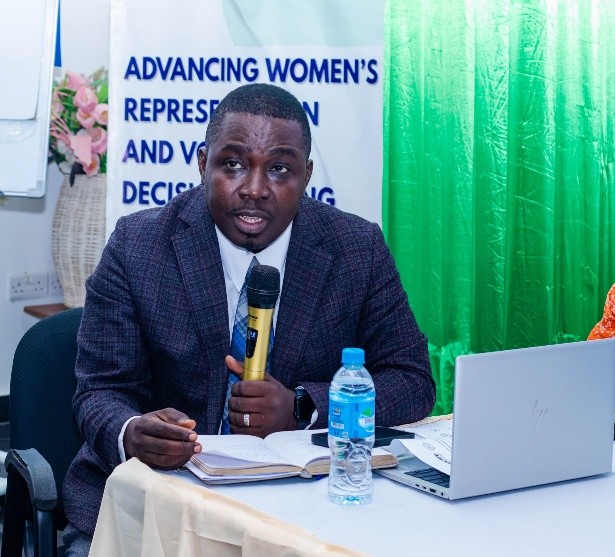
Sahr Kendema shared the 19-point Women’s Empowerment Resolutions submitted to Justice Cowan in 2016, following the release of the first proposed draft of the Constitutional Review Committee (CRC) Report. In presenting the resolutions, he provided a historical background to contextualize the document and explain its development.
According to Kendema, the first draft of the proposed reviewed Constitution, released in February 2016, failed to incorporate key gender equality provisions. Notably, it did not provide for absolute parity between male and female candidates for elective positions, as seen in Senegal’s Parity Law, Article 53 of the Angolan Constitution, and Section 157(2) of the Zimbabwean Constitution. The draft also omitted the recommended minimum 30% quota for women’s representation in elective and appointive positions, as provided for in the constitutions of Eswatini (Swaziland), Burundi, and South Africa.
Further omissions included the absence of provisions reserving one-third (30%) of local government council seats for women, as practiced in Uganda, and the lack of guarantees for gender equity in Parliament, as provided under Sections 24(1) and 259(1)(b) of the Zambian Constitution. The draft similarly failed to reflect provisions requiring gender equality in judicial appointments, as stipulated in Section 184 of the Zimbabwean Constitution and Section 172(2) of the Kenyan Constitution. In addition, equal rights in marriage enshrined in the constitutions of Angola, Equatorial Guinea, Ethiopia, Malawi, and Guinea were not reflected in the first draft.
Kendema noted that these omissions generated significant public criticism. Women across Sierra Leone expressed deep concern, as the draft Constitution failed to address women’s priority policy issues and contradicted key recommendations of the Sierra Leone Truth and Reconciliation Commission (TRC), which strongly supported women’s empowerment. He further observed that discriminatory provisions, including Section 27 of the 1991 Constitution, remained evident in the draft.
In response to these concerns, and in an effort to ensure the integration of women’s priority policy issues into the constitutional review process, the President of the Republic of Sierra Leone encouraged community women, women’s organizations, and institutions working on women’s empowerment to reconvene and resubmit their key demands. Consequently, a National Women’s Conference was organized by the Campaign for Good Governance (CGG), with support from Trócaire-Sierra Leone, on 24 March 2016. The conference was coordinated by Sahr Kendema in collaboration with other partners.
According to Kendema, the conference produced nineteen (19) resolutions, collectively titled *“Many Messages, One Voice.” These resolutions were formally submitted to the Chairperson and members of the Constitutional Review Committee on 15 April 2016 for consideration and integration into the revised Constitution.
Highlights of the 19-Point Women’s Empowerment Resolutions
The resolutions called for a stand-alone chapter on women’s socio-economic and political rights in the reviewed Constitution and included the following key proposals:
- Use of simplified, gender-neutral language throughout the Constitution (e.g., “Chairperson,” “he/she”).
- Equal rights for every citizen to acquire, inherit, use, transfer, access, manage, and administer land and natural resources.
- Inclusion of national values in the Constitution.
- Guaranteed maternity leave with pay for women.
- Extension of social protection to vulnerable persons, including survivors of sexual and gender-based violence (SGBV).
- Equal recognition of civil, Christian, Muslim, and customary marriages.
- Protection of the rights of vulnerable and disadvantaged groups—women, children, and persons with disabilities in access to education.
- Shared parental responsibility for education, maintenance, upbringing, and welfare of children.
- Protection of life, liberty, and personal security, particularly from all forms of violence against women, including SGBV.
- Assurance that courts and law enforcement agencies provide full legal recognition and protection to victims and survivors of SGBV.
- Equality before the law and equal protection and benefit of the law for all.
- Requirement that key leadership positions (Speaker and Deputy Speaker of Parliament, Mayors and Deputy Mayors, Chairpersons and Deputies of District Councils, and similar bodies) shall not be held by persons of the same gender.
- Adoption of a new constitutional provision aligned with the recommendations of the TRC and CRC subcommittees.
- a. No more than 50% of elective and appointive positions to be occupied by one gender.
b. Gender equality in judicial appointments.
c. Gender balance in all constitutional commissions, including:
- Parliamentary Service Commission
- Judicial and Legal Service Commission
- National Electoral Commission
- Independent Media Commission
- Mandatory selection of women candidates by political parties in at least 50% of constituencies and wards in every district, with sanctions by NEC for non-compliance.
- State obligation to address historical gender imbalances against women.
- Establishment of a Gender Equality and Women’s Empowerment Commission entrenched in the Constitution.
- Guaranteed right to education and health, including sexual and reproductive health.
- Entrenchment of a new constitutional right to citizenship.
These resolutions represented a unified national response emerging from the National Women’s Conference of 24 March 2016, following the release of the CRC Abridged Report of February 2016. They consolidated multiple position papers, stakeholder submissions, and consultations conducted between 2013 and 2016, and articulated the collective aspirations of women across Sierra Leone.
In conclusion, Kendema called on the Attorney General and Minister of Justice to make public the full 2025 Constitutional Amendment Bill to enable stakeholders to assess whether women’s priority issues had been adequately integrated. He further recommended that civil society organizations, women’s groups, the media, INGOs, donors, government officials, and diplomats jointly review the 19-point resolutions of 24 March 2016 and the Women’s Communiqué of 27 June 2024 against the Government White Papers of 2017 and March 2021, with the aim of producing a concise, one-page set of priority recommendations for inclusion before the referendum.
Kendema emphasized the urgency of coordinated and accelerated engagement, drawing parallels with the strategic unity that led to the successful passage of the Gender Equality and Women’s Empowerment (GEWE) Act, 2022. He stressed that a unified strategy anchored in the principle of “Many Messages, One Voice” is essential to ensuring that citizens’ priorities are fully reflected in the revised Constitution.
He further urged stakeholders to act swiftly, noting that on 27 January 2026, the Attorney General laid the Amendment Bill in Parliament for its first reading, with the second reading scheduled within two weeks. He described this period as a narrow but decisive window for engagement, warning that failure to act decisively could significantly undermine prospects for substantive constitutional reform—an opportunity that may not arise again for several decades.
Sahr Kendema concluded by sharing the 19-point resolutions of 24 March 2016, responses to the CRC Draft Abridged Report of 2016, the Women’s Communiqué of 24 July 2024, and the Government White Papers of 2017 and 2021 with CSOs, women’s groups, the media, INGOs, donors, government officials, and diplomats to support informed analysis and effective engagement in the ongoing constitutional review process.