By Hassan Solokoh Bockarie
In the decades following the end of the civil conflict in Sierra Leone, a silent but enduring crisis persists: the ongoing economic and social marginalisation of war widows. These women, as defined by the Truth and Reconciliation Commission (TRC), are those whose husbands “were killed as a consequence of any abuse or violation and who, as a result, have become the primary breadwinners for their families.” They continue to face profound barriers to rebuilding their lives with dignity.
During and after the war, war widows encountered multiple layers of disadvantage. The TRC found that many of these women were prevented from owning land, inheriting property, or accessing the economic opportunities that their husbands once held. Customary practices of “widow inheritance” and property takeovers by male relatives further compounded their vulnerability.
Alice Mondeh, a war widow who recently travelled from Motema, Kono District, to visit her three daughters in Graton, recounted how her husband and youngest daughter were shot during the war in Kono. “My husband was killed during the war when the rebels attacked,” Alice recalled. “His elder brother told me to stay with him or lose the land and property.” Her story reflects the TRC’s description of the breakdown of the social protections that once helped widows and elderly women after the war.
Although the government and development organisations have attempted to respond, the challenges remain vast. The National Commission for Social Action (NaCSA) was designated to implement the reparations program recommended by the TRC, which includes microcredit, skills training, and monthly pensions for beneficiaries. However, funding shortfalls and structural barriers have hampered its impact. In 2009, it was reported that while war widows were registered, they would not receive benefits until at least 2010 due to a shortage of funds.
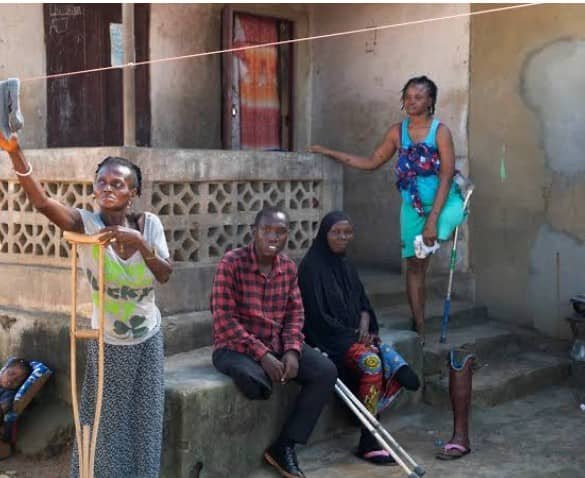
Fudia Sheriff, a widow from Limba Corner, Rokel, still bears the scars of the war. Rebels mutilated her and her infant daughter before killing both her baby and her husband. She has struggled with flashbacks and nightmares of that incident. “They told me I was registered and that I would get training and support, but no one came,” she explained, stating that she sells ginger and water in her area to help raise her four children.
Her experiences reflect the TRC’s finding that many war-affected women lack access to formal employment and suffer from structural discrimination in the social, economic, and family spheres.
The TRC report did not merely document suffering; it made specific recommendations regarding reparations. The TRC’s detailed recommendations can be found in Chapter 3, Volume 2, Paragraphs 43-44 of the TRC final report. These recommendations outline the need for a comprehensive reparations program, including healthcare, financial assistance, housing, and skills training for war survivors.
Mrs Melrose Karminty, Minister of Social Welfare, has publicly committed to supporting these initiatives. In a 2024 address to the Global Fund for Widows during the UN Commission on the Status of Women, she emphasised the importance of microloans, training, and trade facilitation centres for women, including widows. Mrs Karminty highlighted the social, cultural, and economic barriers that prevent widows from having their voices heard, fully participating in society, and achieving self-determination. “Widows are often isolated and blamed for their husbands’ deaths,” she explained. “This stigma, discrimination, and grief compound the financial insecurity they face.”
Mrs Karminty also outlined the Sierra Leone government’s commitment to supporting widows. She cited the Gender Justice Laws, including the Domestic Violence Act, the Devolution of Estate and Property Act, and the Registration of Customary Marriage Act, as legislative measures aimed at promoting financial empowerment and ensuring widows’ rights to inheritance.
Despite these efforts, many war widows remain in limbo. The reparations program was initially supported by a UN Peacebuilding Fund of US$3 million, which is insufficient relative to the scale of need.
There are, however, some positive developments. Some widows report receiving microgrants, training, and integration into women’s business networks. Civil society groups, such as the Women’s Forum Sierra Leone, have raised awareness of gender equality and issues affecting widows.
For instance, Mariatu Kanu, a widow in Grafton, shared that she completed a cloth-weaving training program and is now part of a women’s cooperative that is beginning to access local markets. “It’s been hard, but I feel I have a chance now. I have tools and hope,” she stated.
The women whose husbands died in Sierra Leone’s conflict carry significant burdens: economic insecurity, social exclusion, the challenges of single parenthood, and the erosion of customary protections. The TRC identified them as among the most vulnerable. But being recognised is one thing; achieving real support and empowerment is another.
This article is produced with support from Media Reform Coordinating Group (MRGC) through Africa Transitional Justice Legacy Fund – ATJLF project “On engaging the media and communities to change the narrative on Transitional Justice (TJ) issues in Sierra Leone.”