By Hassan Solokoh Bockarie
More than two decades after the guns fell silent, Sierra Leone continues to grapple with how it remembers its 11-year civil war (1991–2002). The country has taken important steps to preserve the collective memory of the conflict, yet these efforts remain uneven, shaped largely by international support, civil society activism, and, only recently, more deliberate state-led initiatives.
For many years, remembrance depended mainly on non-state actors and local communities. In some places, “social forgetting” became a coping mechanism, allowing survivors to move forward from the horrors of war. Formal integration of war memory into education and national consciousness remained limited, and government-led memorialization progressed slowly—until now.
National Remembrance Day: A Turning Point
A significant milestone was reached with the establishment of January 18 as National Remembrance Day, marking the date the war was officially declared over in 2002. On 11 December 2025, President Julius Maada Bio proclaimed January 18 a nationwide public holiday dedicated to honoring victims of the civil war, reflecting on the conflict, and recommitting to peace.
“You will recall that the Truth and Reconciliation Commission was established to create an impartial record of the civil war the country experienced, and the report also made recommendations for lasting peace,” President Bio said in his national address.
The Truth and Reconciliation Commission (TRC) specifically recommended that January 18—the day President Ahmad Tejan Kabbah declared the conflict over in 2002 be commemorated as National Reconciliation Day.
Describing the declaration as historic, President Bio noted that, for the first time, Sierra Leoneans would come together on a single, dedicated day to remember the war and the heavy price paid to secure peace.
“My fellow Sierra Leoneans, at home and across the world, today our nation stands still,” he said. “We pause together to remember. We pause to honour. We pause to reflect.”
Memory Projects and Sites of Conscience
Beyond official declarations, several initiatives continue to play a crucial role in preserving war memory. The Sierra Leone Memory Project, working alongside the Center for Memory and Reparations, focuses on recording oral histories, digitizing TRC records, and establishing sites of conscience aimed at preventing a recurrence of violence.
The Center for Memory and Reparations welcomed the proclamation of National Remembrance Day, expressing gratitude to President Bio for responding to its long-standing advocacy. Quoting Nelson Mandela, the Center remarked: “It is in your hands now.”
This renewed national focus echoes the words of the late President Ahmad Tejan Kabbah, spoken in Lungi on January 18, 2002: “We are happy that those flames of war have been extinguished, and that now we are about to watch the Flame of Peace.”
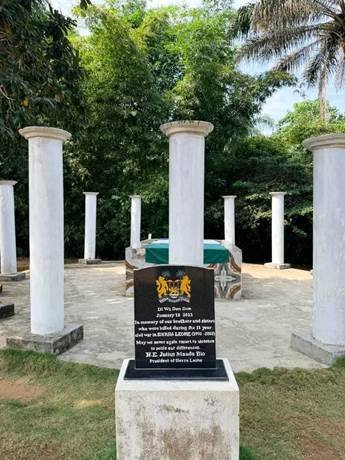
Another important space for remembrance is the Peace Museum and Memorial Garden, located on the former site of the Special Court for Sierra Leone. The museum documents the war through exhibitions, artifacts, and photographs, while the Memorial Garden features symbolic mass graves representing each of the country’s 16 districts, offering a place for reflection, mourning, and healing.
Remembering at the Sites of Atrocity
National remembrance activities have also renewed attention on communities that bore the brunt of the conflict. According to Attorney General Alpha Sesay, commemorations in Kailahun District—where rebel forces launched their first attack in 1991 were deeply emotional.
Victims Still Waiting for Justice and Support
Despite progress in remembrance, serious concerns remain about the lived realities of war victims. Many amputees, war widows, and survivors continue to struggle with poverty, discrimination, and inadequate support.
Speaking on Truth Media, Sidimba Elizabeth Kargbo, a war amputee, recounted losing her arm and nearly losing her breast during the conflict. Beyond the physical pain, she continues to face social stigma. While family support sustains her, her story highlights the urgent need for remembrance to translate into tangible assistance for survivors.
An Ongoing Journey
The introduction of National Remembrance Day and the work of institutions such as the Peace Museum mark important progress in preserving Sierra Leone’s war memory. However, the process remains in its formative stages. Collective remembrance still relies heavily on individuals, civil society, and international partners, rather than a sustained and comprehensive state-led investment—particularly in education, victim support, and institutional memory.
As Sierra Leone continues to consolidate peace and strengthen its democracy, remembering the past is not only about honoring victims. It is about learning, healing, and ensuring that the horrors of the civil war are never repeated.
This article is produced with support from the Media Reform Coordinating Group (MRCG) through the Africa Transitional Justice Legacy Fund (ATJLF) project “On engaging the media and communities to change the narrative on Transitional Justice (TJ) issues in Sierra Leone.”