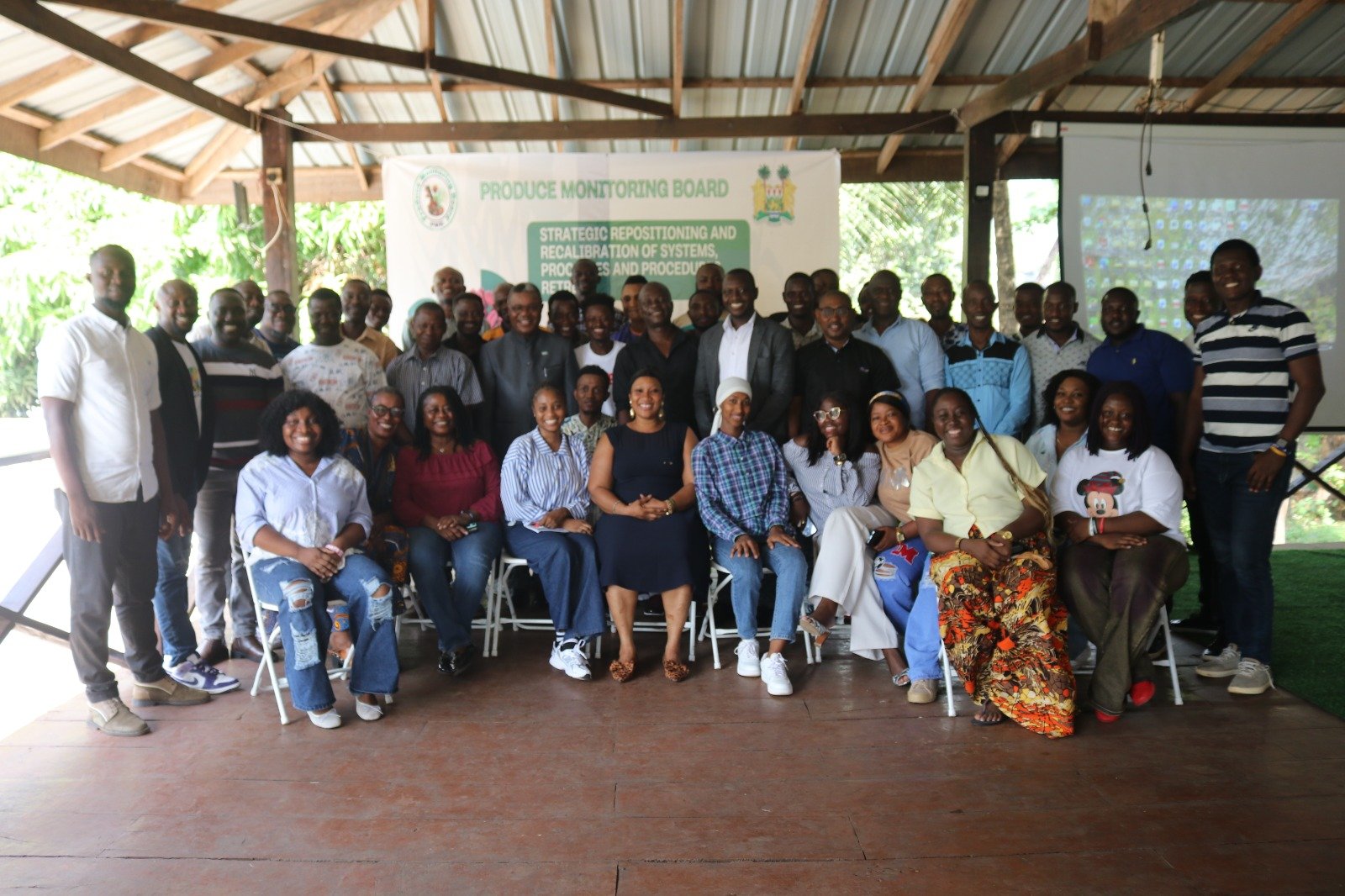
The Produce Monitoring Board (PMB) has taken a decisive step towards strengthening institutional effectiveness with a two-day (13- 14 January, 2026) Strategic Repositioning and Recalibration Retreat on systems, processes, and procedures held at King’s View Resort, Sussex, Freetown. The retreat, themed “PMB Driving Institutional Reform for Effectiveness,” focused on repositioning the Board as a premier government commodity regulatory agency.
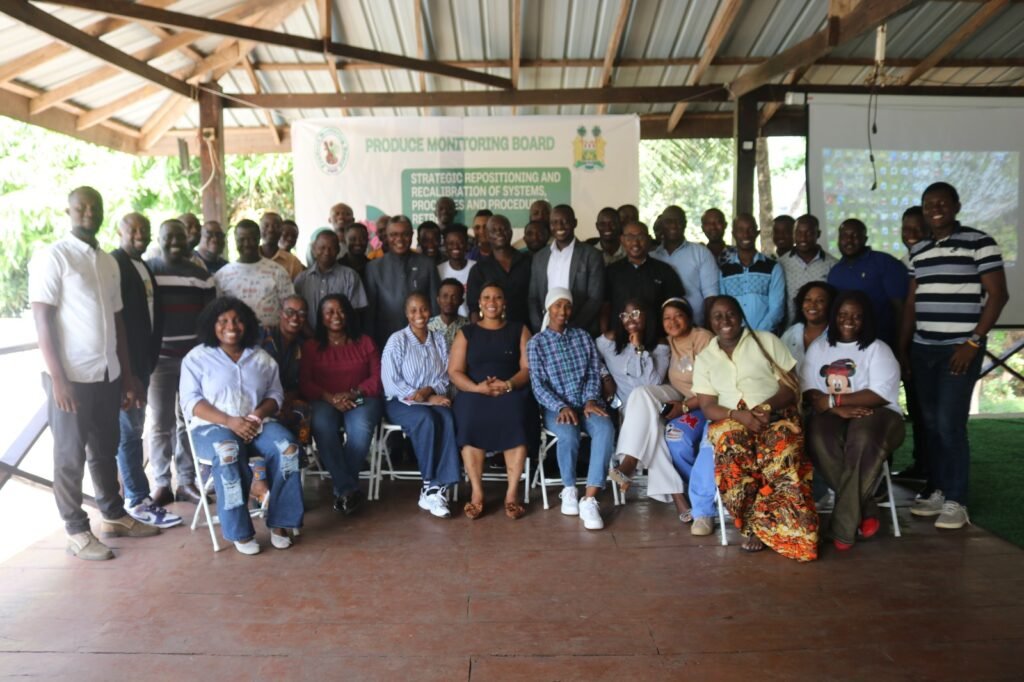
Opening the retreat, the Executive Chairman of PMB, Mr. Raymond Bob Katta, said the engagement was deliberately structured to strategically and programmatically reposition the institution as a responsive, agile, and results-driven regulator capable of delivering on its broad national mandate.
Mr. Katta explained that the retreat provided a critical platform for institutional self-assessment, forward planning, and strategic alignment. It enabled PMB to review its operational approaches, assess progress under the ongoing reform agenda, and adopt work plans and process frameworks aligned with current and emerging challenges in the produce sector.
He outlined the key objectives of the retreat, which included reviewing PMB’s service delivery and operational systems to ensure alignment with its mandate; strengthening core functional units such as Monitoring and Evaluation (M&E), research, project management, resource mobilization, and communications; and developing real-time performance measurement and benchmarking tools.
The Executive Chairman noted that while Sierra Leone has commodity-specific policies for crops such as cocoa, cashew, and oil palm, the absence of a comprehensive national produce sector policy continues to hinder effective coordination and regulation.
“Although the legislative framework exists, the policy environment remains weak. A holistic produce sector policy would significantly strengthen regulation, improve coordination, and enhance PMB’s contribution to government revenue and farmer welfare,” he said.
Mr. Katta emphasized that the retreat is expected to deliver tangible outcomes, including a restructured operational framework, a refined service delivery model responsive to modern challenges, a clear implementation roadmap to strengthen revenue mobilization and institutional capacity, and streamlined business support systems to improve efficiency.
“For PMB, value for money means becoming more responsive, more accountable, and more impactful in both revenue generation and service delivery,” he stressed.
As part of the retreat, participants reflected on PMB’s performance across the 2024/2025 operational and fiscal years through a three-phase lens—Then (2018–2024), Now (2025–2026), and the Future (beyond 2026)—to draw lessons from the foundation phase, consolidate reforms, and chart a sustainable path for long-term national impact. This session was facilitated by the Director of Operations, Mr. Didan Sankoh.
The Lead Facilitator, Dr. Emmanuel Gaima, Principal Executive Advisor to the President for the Public Service and Head of the Public Service, said his participation underscored President Julius Maada Bio’s strong commitment to revitalizing state institutions, including PMB. He noted that the Board’s reform agenda aligns with the President’s vision of strengthening the economy while improving livelihoods, particularly in rural farming communities.
Dr. Gaima highlighted the need for an overarching public sector policy framework, an update of the PMB Act—which he described as outdated—and a stronger institutional focus on technical competence, customer service, and effective delivery of the core mandate.
In his strategic role within the public service, Dr. Gaima said he would provide technical guidance to support PMB’s transformation into a more productive, agile, and strategically focused institution. He added that the reforms would enable PMB to increase its contribution to the national treasury, explore sustainable self-financing mechanisms, and reinvest in research, staff development, and institutional growth—positioning the Board as one of government’s most efficient and sustainable revenue-generating agencies.
He further advised PMB to deepen engagement with farmers, exporters, and agribusinesses by strengthening advisory services, research, marketing support, and regulatory processes.
Key activities undertaken during the two-day retreat focused on recalibrating PMB’s systems, processes, and procedures to enhance institutional performance, efficiency, and sustainability. The sessions were led by expert facilitators and included:
Review of PMB’s mandate and institutional status, and identification of gaps – facilitated by the Lead Facilitator, Dr. Emmanuel Gaima.
Strengthening Monitoring and Evaluation (M&E) systems to improve performance tracking and accountability – facilitated by Mr. Tom Menjor.
Upgrading Information Technology (IT) systems to enhance data management, transparency, and real-time reporting – facilitated by Dr. Kuyembeh.
Reviewing Human Resource structures to better align staff capacity and performance management with strategic objectives – facilitated by Mr. Kweku Djang.
Developing a robust Communication Plan to improve stakeholder engagement and institutional visibility – facilitated by Mr. Haroun Sheriff.
Strengthening Resource Mobilization strategies to diversify revenue streams, reduce reliance on subventions, and reinforce corporate responsibilities – facilitated by Dr. Emmanuel Gaima.
Drafting a comprehensive Operational Plan to guide the implementation of reforms – facilitated by Dr. Emmanuel Gaima.
These interventions collectively aim to promote efficiency, accountability, and responsiveness across the institution.
At the close of the retreat, departments committed to implementing the PMB Operational Plan 2026, signalling a shared resolve to translate strategy into action.
The strategic retreat marks a pivotal milestone in PMB’s transformation into a modern, efficient, and performance-driven institution positioned to drive agricultural growth, support farmers, and contribute significantly to Sierra Leone’s national development.