By Adonis Francis
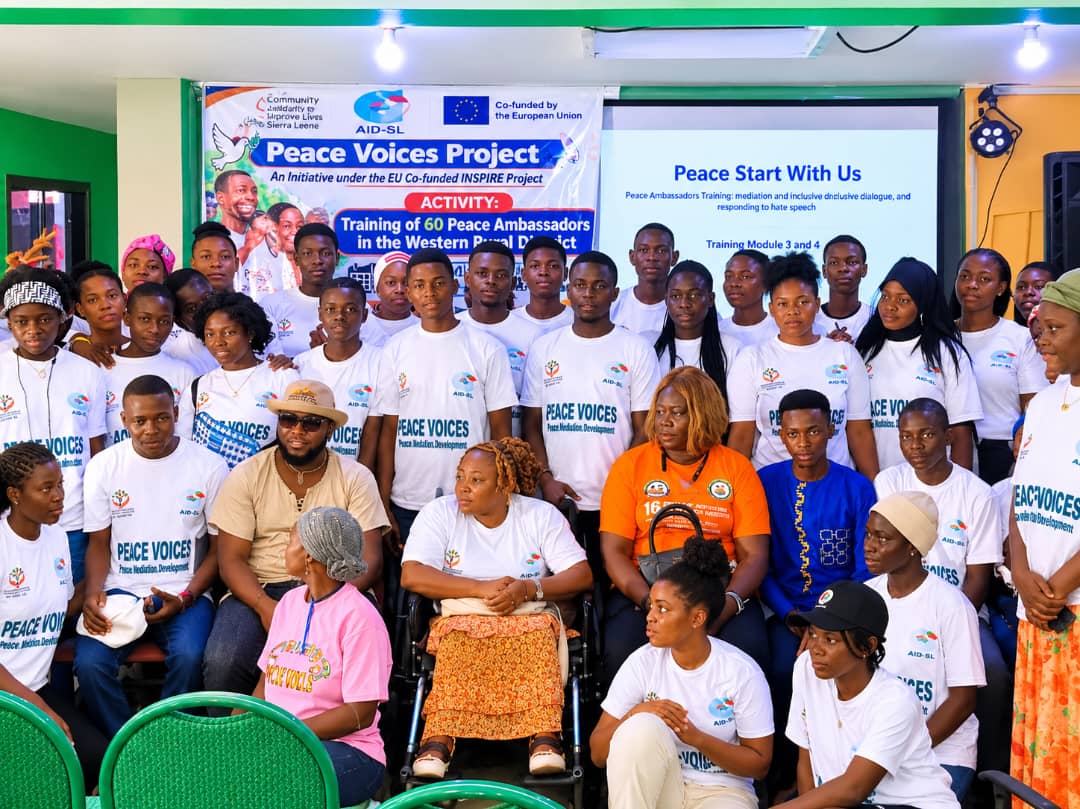
Community Solidarity to Improve Lives Sierra Leone (ComSIL-SL), with support from the European Union (EU) and Aid-SL, has trained 60 Peace Ambassadors in the Western Rural District as part of efforts to strengthen peacebuilding, community cohesion, dialogue, and conflict prevention at the grassroots level.
The training took place on Friday, 27th November 2026, at the Magic Centre, Kossoh Town, Jui, Freetown, bringing together community stakeholders and youth representatives to equip them with the knowledge and skills needed to promote peaceful coexistence and address conflicts within their communities.
The initiative is aimed at empowering participants to serve as peace advocates, helping to resolve disagreements through dialogue, mediation, tolerance, and mutual understanding rather than violence or confrontation.
Speaking at the training, Executive Director of Community Solidarity to Improve Lives Sierra Leone (ComSIL-SL), Alpha Barkarr Barrie, emphasized the importance of strengthening community-based peacebuilding structures, noting that sustainable peace requires the active participation of citizens at every level of society.
He encouraged the newly trained Peace Ambassadors to take ownership of peace within their respective communities, become responsible voices against violence, and help prevent conflicts before they escalate.
Mr. Barrie also underscored the importance of community engagement, tolerance, and constructive dialogue in addressing local challenges, stressing that peacebuilding is a collective responsibility that requires cooperation among young people, community leaders, women, and other stakeholders.
He further encouraged participants to use the knowledge and skills acquired during the training to promote unity, build trust, foster reconciliation, and strengthen relationships among community members.
Speaking on the topic “The Role of Peacebuilding in Local Communities,” Ambassador Marie Bangura, District Youth Chairlady of WADC, underscored the importance of young people taking an active role in maintaining peace and stability within their communities.
She emphasized that peacebuilding should not be left solely to government, security institutions, or traditional authorities, but must involve ordinary citizens, especially young people, who have a critical role to play in preventing conflicts and promoting unity.
Meanwhile, Mohamed Momoh Foday, Development Planning Officer of WARD C, highlighted the importance of peacebuilding in promoting sustainable development at the local level.
He explained that peace and development are closely connected, noting that communities cannot achieve meaningful progress in the absence of stability, cooperation, and trust among their residents.
According to him, peacebuilding creates an enabling environment for development programmes, community participation, social services, and economic activities to thrive.
He encouraged the Peace Ambassadors to use the knowledge gained from the training to identify potential sources of conflict within their communities, engage stakeholders, and promote peaceful solutions to disagreements.
Participants, who are now recognised as Peace Ambassadors, also shared their experiences, reflections, and appreciation for the training, describing it as an important opportunity to strengthen their understanding of peacebuilding and conflict prevention.
The Peace Ambassadors expressed commitment to taking the lessons learned from the training back to their respective communities and sharing them with others, while serving as agents of peace, unity, reconciliation, and social cohesion.
The 60 Peace Ambassadors are expected to contribute to promoting peace, encouraging dialogue, strengthening social relationships, and supporting conflict prevention initiatives across the Western Rural District.
The intervention forms part of broader efforts by ComSIL-SL, with support from the European Union and Aid-SL, to strengthen local capacities for peacebuilding and promote inclusive, peaceful, and resilient communities.
The organisers believe that empowering community members with peacebuilding knowledge and practical skills will help foster a culture of tolerance, understanding, accountability, and peaceful coexistence, particularly among young people.
As Sierra Leone continues to strengthen its peace and democratic processes, initiatives of this nature remain important in ensuring that peace is not only maintained at the national level but also nurtured within neighbourhoods, communities, and families.