By Komba Fillie
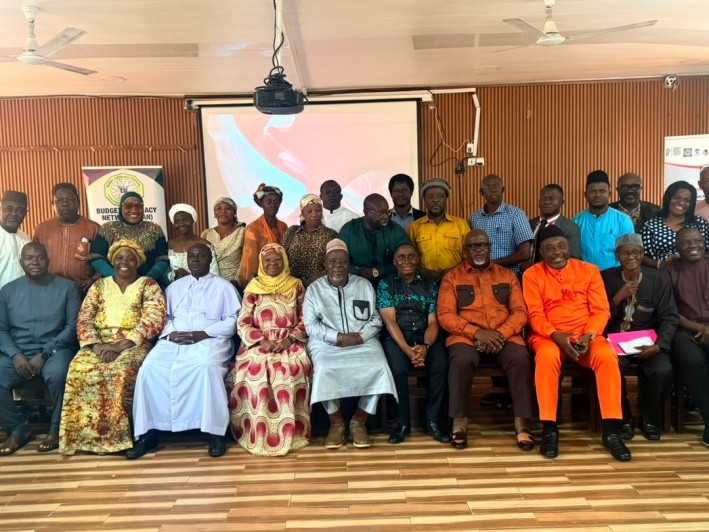
The Budget Advocacy Network on Tuesday 18th August 2026 concluded a one-day comprehensive training for members of the Inter-Religious Council on Public Financial Management at the Council of Churches conference hall in Freetown, marking a significant step towards strengthening grassroots oversight of public resources in Sierra Leone.
Making his presentation, National Coordinator, Mr. Abubakarr Kamara, underscored the importance of the training, noting that it seeks to equip religious leaders across the country with the knowledge to monitor how government raises, allocates and spends public money.
He explained that the initiative comes at a time of growing public concern over financial irregularities in government contracts and seeks to harness the moral authority and community trust that religious leaders command to promote transparency and responsible stewardship of the nation’s resources.
Mr. Kamara outlined that Public Financial Management, commonly known as PFM, encompasses the full journey of public money from collection to final use, covering revenue generation, planning, budgeting, spending, accounting, reporting, auditing and oversight. He noted that these processes are all governed by Sierra Leone’s PFM Act of 2016, and that good PFM promotes budget credibility, fiscal discipline and effective service delivery.
He cited that the timing of the training is particularly poignant given recent controversies surrounding donor-funded projects, including the unresolved $37,200 payment shortfall in the ECOWAS Solar Streetlight project at Lungi, where a contractor was left with only half his payment despite completing verified work.
Under the training programme, religious leaders are being taught to understand the budget cycle’s four main stages: preparation, approval, execution, and reporting with audit and oversight. Participants are learning that each stage presents an accountability question—whether money was raised legally, whether it was budgeted and approved, whether it was spent for the intended purpose, and whether it was properly reported and audited.
A key focus of the sessions is public procurement, where government obtains goods, works and services using public resources. Religious leaders are being trained to recognise red flags that may signal problems, including situations where one supplier appears to dominate repeated contracts without clear explanation, specifications seem unusually tailored to a particular supplier, contracts are repeatedly cancelled or changed, or payments are reported while visible work remains incomplete.
Mr. Kamara emphasised that red flags should trigger verification and appropriate referral, not public accusations. Participants are being equipped with practical monitoring checklists to use when visiting project sites, asking questions about whether there is a visible project signboard, who the implementing institution is, whether materials and workmanship are of reasonable quality, and whether intended users have started receiving expected benefits.
On the issue of public debt, which stood at NLe69.87 billion at the end of December 2024 according to the Ministry of Finance, religious leaders are learning to distinguish between productive borrowing and risky debt accumulation. External debt accounted for NLe41.52 billion of the total, while domestic debt stood at NLe28.35 billion. Participants are being taught to ask critical questions: why is government borrowing, what specific public problem will the loan solve, how much will be borrowed and at what total repayment cost, and what will happen to essential services if debt service increases?
The training also covers audit accountability, with religious leaders learning to follow audit findings from the Audit Service Sierra Leone and advocate for corrective action. They are being encouraged to ask six fundamental questions: what exactly did the Auditor-General find, which institution is involved, what amount of public money is at stake, what explanation was provided by the responsible institution, what recommendation was made, and has the problem actually been fixed?
Religious leaders are being reminded that their role is community stewardship, not partisan politics. They are encouraged to ask informed questions, verify information, engage with responsible institutions through formal channels, and work alongside civil society organisations and the media when technical evidence is needed.
The training carries a powerful message: public money belongs to the public and must be managed as a public trust. Religious leaders are being challenged to help their communities move from asking merely what government promised to asking what was actually budgeted, spent and delivered.
Participants are urged to choose one public project or service in their community and apply three questions: what was promised, what was spent, and what was delivered?
However, participants at the training raised serious concerns about how religious leaders have historically been excluded from budget advocacy processes. Several expressed frustration that politicians frequently tell them they are not politicians but religious leaders and should stay away from politics, while others cited biblical passages to argue that it is their right to be part of politics and any other development activities in the country.
The Budget Advocacy Network continues to expand the programme, recognising that faith communities, with their deep reach into every corner of Sierra Leone, can play an invaluable role in promoting honest stewardship, responsible citizenship and the accountable use of public resources that affect the schools, hospitals, roads and water supplies used by congregations across the nation.