By Hassan Solokoh Bockarie
More than two decades after the guns fell silent, the unfinished legacy of Sierra Leone’s eleven-year civil war continues to shape the lives of those who were pulled into the conflict as children. Despite strides in peacebuilding, many former child soldiers say that the justice and support once promised to them have faded into silence.
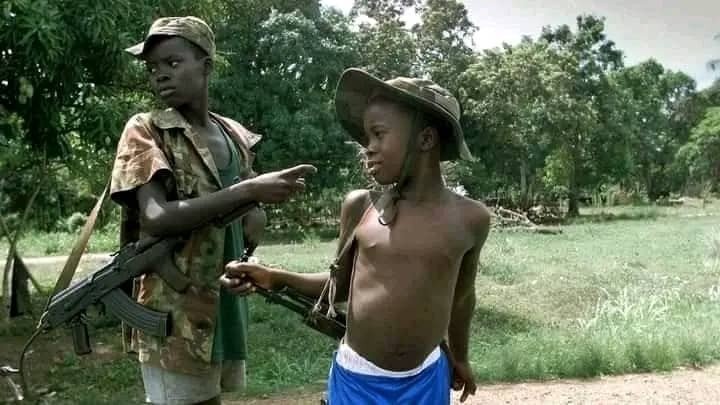
In the immediate post-war years, the Truth and Reconciliation Commission (TRC) and the Special Court for Sierra Leone (SCSL) offered hope for accountability and national healing. Yet for many now-adult survivors, the early momentum did not translate into long-term rehabilitation. While some have rebuilt their lives against overwhelming odds. Others remain trapped by trauma, stigma, and poverty.
Ibrahim, abducted at the age of nine by the Revolutionary United Front (RUF) in Magburaka, Tonkolili District, survived several near-fatal encounters before escaping to Freetown. Today, he is widely known for his craftsmanship in carpentry and steel bending in Freetown and beyond.
“There was no counselling, no real reintegration,” he says. “We were left on our own. I made it, but most didn’t. Many of us were simply pushed back into society with no support or healing.”
One of those still struggling is Umaro Mansaray, now 33 and a father of three, Mansaray fights daily to survive on the margins of society. He was abducted at around nine years old while running an errand in Nimikoro Chiefdom, Kono District, and forced into combat. After years in the bush, he eventually fled to Freetown, believing his life was in imminent danger.
“When we arrived at Government Wharf, they brought us to Cockrill for ECOMOG to screen us,” he remembers. “They suspected us of being spies. We were very scared. Later, the government promised reintegration, but it never really happened.”
Decades later, Mansaray states that he remains burdened by the label ‘rebel,’ a stigma that persistently denies him opportunities and diminishes his dignity. “I was a child and had no say in the matter, but society still judged me,” he says. “Most of us need education, housing, and a job. We want to live as individuals, not as ex-combatants.”
The TRC’s 2004 report was explicit: children conscripted into armed groups required long-term rehabilitation, psychosocial counselling, education, and vocational training. The SCSL focused on prosecuting those most responsible for wartime atrocities. But the deeper social repair envisaged by the TRC remains largely incomplete.
The detailed recommendations can be found in vol.4, chp.5, sec.100-209, p250-265 of the TRC final report. These areas outline the call for a comprehensive reparations program, including healthcare, financial assistance, housing, and skills training for survivors of the war.
Even state leaders acknowledge the gaps. In 2023, former Chief Justice Desmond Babatunde Edwards warned that meaningful transitional justice demands stronger institutions, judicial independence, and consistent access to justice. And in March 2025, Attorney General Alpha Sesay reaffirmed the Government’s commitment to fairness, non-discrimination, and inclusive legal reforms.
Yet civil society remains sceptical. A 2023 report by Campaign for Good Governance noted that despite legislative progress, former child soldiers remain largely invisible in national development planning.
UNICEF has been a key agency supporting family tracing and reunification of separated children under the then Ministry of Social Welfare, Gender, and Children’s Affairs. Out of the 7,311 recorded separated children, 6,281 have been successfully reunified with their families. UNICEF says it continues to support the remaining children who cannot yet be reunited.
According to UNICEF, reunification was not possible for everyone. Some families could not be traced; others rejected their returning children due to stigma or fear.
One former child combatant, Musa Amara, recounts the pain of being rejected by his own father. “When I came to Freetown, I tried to stay with my father, but he rejected me. I had to stay in the streets. He said he is no longer my father because I was a rebel. I tried to explain that it was not my fault, but he would not listen. I became devastated and started smoking, and drinking alcohol in the street.”
Many abducted children describe daily life under the RUF as a routine of brutality, forced labour, and indoctrination. Survivor from Njagbwema Faima (Kono) Kai Mane recalled that every morning there was a roll call to share duties. Some would find food, some would fish, some would cook, and others would be sex workers. “Little children carried heavy loads. After all the day’s work, they ate, and we survived on cassava,” Mane added.
Girls suffered uniquely harsh experiences. In addition to combat roles, many were used as sex slaves or domestic servants. One 30-year-old survivor recalls, “It was sometime in 1997 during the attack in Fadugu. I was abducted with two others. I was taken to Kono to help the wife of an RUF member who was pregnant.”
According to a 2005 U.N. report titled Disarmament, Demobilization, Reintegration and Stability in Africa, about 71,000 ex-combatants were disarmed and demobilised. But many former fighters say that the programme did not work.
Tamba Fasuluku was known as “Rainu” when he was the commander of a rebel faction called the West Side Boys. Fasuluku says that he was fortunate to be reintegrated into society and now works as a pastor. But he says that many of the young boys his forces conscripted have not been so lucky.
“It pains me now to see these young boys languishing on the streets without jobs,” says Fasuluku. “They have also become easy targets for greedy politicians who use these boys to cause trouble in society.”
For many former child soldiers, the war has ended, but the struggle continues. Trauma, family rejection, poverty, and stigma have pushed some into substance abuse and life on the streets. Their voices serve as a stark reminder of Sierra Leone’s unfinished business with accountability and reintegration.
As the nation continues to define its post-conflict identity, these testimonies echo a collective plea—not merely for assistance, but for recognition, dignity, and the fulfilment of promises made more than twenty years ago.
This article is produced with support from Media Reform Coordinating Group (MRGC) through Africa Transitional Justice Legacy Fund – ATJLF project “On engaging the media and communities to change the narrative on Transitional Justice (TJ) issues in Sierra Leone